
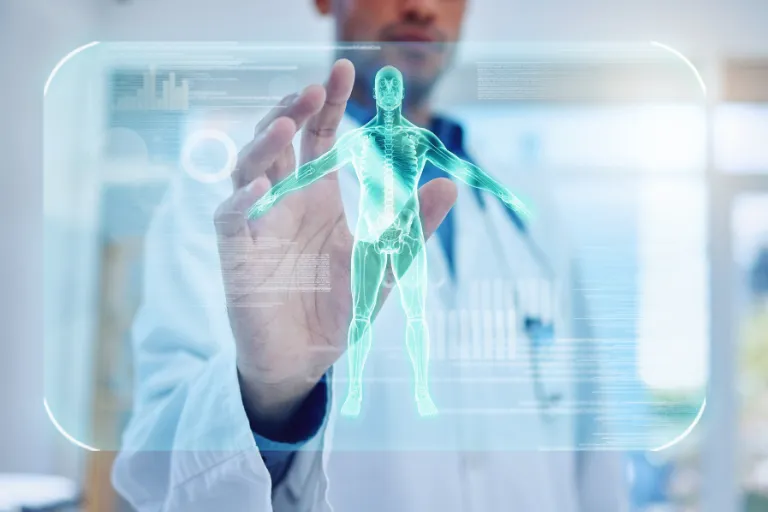
Wichtige Punkte
- Künstliche Intelligenz (KI) verändert das Gesundheitswesen durch Verbesserungen in den Bereichen Diagnostik, Therapieplanung, Arzneimittelforschung, Patientenüberwachung und Verwaltungseffizienz.
- Zu den Vorteilen gehören genauere Ergebnisse, schnellerer Zugang zur Versorgung und zunehmend personalisierte Lösungen.
- Es bleiben Herausforderungen bestehen: ethische Dilemmata, Risiken für den Datenschutz, Verzerrungen in Algorithmen und die Notwendigkeit menschlicher Aufsicht.
- Die Zukunft des Gesundheitswesens könnte ein hybrides Modell mit sich bringen, bei dem KI medizinisches Fachpersonal ergänzt, anstatt es zu ersetzen, wodurch die Versorgung intelligenter, zugänglicher und individueller gestaltet wird.
Ein Blick in die Klinik von morgen
Imagine walking into a clinic where your health professional reviews not only your medical history but also insights from an AI system that has analyzed thousands of similar cases in seconds. The AI provides insights on the best therapy plan, predicts potential risks, and even suggests personalized lifestyle changes – all before your appointment ends.
This is not science fiction; it’s a glimpse into a healthcare future that is already unfolding. Artificial intelligence is no longer confined to labs or tech companies – it’s now part of everyday medicine, from radiology scans to wearable devices that monitor heart palpitations and sleep problems. Experts suggest that AI could help reduce medical errors, improve access to care, and make therapies more precise. Yet, as powerful as it is, AI raises questions about trust, fairness, and the role of human judgment in health decisions.
Warum KI im Gesundheitswesen für Nutzer und Pflegekräfte wichtig ist
Healthcare has always been about solving one problem: how to deliver better care to more people, faster and more effectively. Yet today’s system struggles with long wait times, rising costs, and uneven access across different regions and communities.
Enter AI – a technology once considered futuristic – is now part of routine healthcare workflows. For users, this means faster results, fewer missed diagnoses, and therapies that are increasingly personalized. But as with any breakthrough, AI comes with both opportunities and risks. Understanding both sides is crucial, because these innovations won’t just shape the future of healthcare – they’ll shape your own health journey.
Aktuelle Anwendungen der KI: Von der Diagnostik bis zur Arzneimittelentwicklung
KI taucht bereits auf eine Weise auf, die Ihnen vielleicht gar nicht auffällt:
- Intelligentere Diagnostik: AI systems now analyze X-rays, MRIs, and pathology slides with accuracy that in some cases matches or exceeds human experts.
- Individuelle Therapieplanung: In cancer care, AI helps design targeted therapy plans by analyzing genetic data and historical outcomes.
- Echtzeitüberwachung: AI-enabled wearables track symptoms such as heart palpitations or irritable gut patterns, alerting users and health professionals to early warning signs.
- Beschleunigte Arzneimittelentwicklung: By analyzing millions of compounds, AI speeds up the process of finding new drugs that would otherwise take years.
- Optimierte Verwaltung: Hospitals use AI to reduce paperwork, optimize scheduling, and cut costs, freeing health professionals to spend more time with users.
Die Auswirkungen sind klar: schnellere Diagnosen, bessere Prävention und effizientere Versorgung. Diese Fortschritte machen jedoch auch kritische Herausforderungen deutlich.
Die Wissenschaft hinter KI in der Medizin
At its core, AI in healthcare relies on machine learning—training algorithms to recognize patterns in massive datasets. For example, medical imaging AI learns by comparing millions of labeled scans, improving its ability to detect disease with every iteration.
But the power of AI is only as strong as the data behind it. If datasets are incomplete or biased, AI systems may unintentionally reinforce existing healthcare disparities. That’s why regulatory bodies like the U.S. Food and Drug Administration (FDA) and the European Medicines Agency (EMA) are developing frameworks to ensure AI-driven solutions meet standards for accuracy, safety, and fairness.
Vorteile und Chancen: Wie KI die Pflege verbessert
„Für Nutzer, Pflegekräfte und Fachkräfte verspricht KI echte Vorteile:
- Frühere Erkennung von Symptomen — AI can spot signs of disease earlier than traditional methods, which may improve long-term outcomes.
- Personalisierte Lösungen Durch die Analyse von Genetik, Lebensstil und Umwelt kann KI individuell zugeschnittene Therapien empfehlen.
- Erhöhte Effizienz — By handling administrative tasks, AI reduces burnout among health professionals.
- Erreichbarkeit — AI tools can expand access in underserved areas, offering diagnostics and monitoring without requiring large specialist teams.
Ethische Herausforderungen und Fragen der Gerechtigkeit
Der Aufstieg der KI im Gesundheitswesen bringt auch dringende Herausforderungen mit sich:
- Datenschutz: Sensitive health records must be protected from misuse or breaches.
- Bias in Algorithms: AI trained on limited datasets may work less effectively for certain populations.
- Übermäßige Abhängigkeit von Maschinen: AI is not infallible—it requires human oversight to catch errors and ensure ethical use.
- Ungleicher Zugang: High costs and limited infrastructure may leave lower-income regions behind, widening health gaps.
Beispiel aus der Praxis: KI in der Augengesundheit
In 2023, the FDA authorized an AI system for detecting diabetic retinopathy, a leading cause of blindness. Users can now undergo a simple eye exam at their primary care clinic, with AI providing results within minutes. Instead of waiting weeks for a specialist, those at risk are referred more quickly, preventing complications and improving outcomes. This real-world case shows how AI is already transforming everyday healthcare.
Ausblick: Die Zukunft der KI und Ihre Gesundheit
Bei KI im Gesundheitswesen geht es nicht darum, Menschen zu ersetzen, sondern darum, die Möglichkeiten zu erweitern. Die Zukunft wird wahrscheinlich hybrid sein: Menschen und KI arbeiten zusammen, um eine schnellere, genauere und individuellere Versorgung zu gewährleisten.
Für Nutzer kann dies frühere Diagnosen, gezielte Therapien und einen bequemeren Zugang zur Gesundheitsversorgung bedeuten. Für medizinisches Fachpersonal bedeutet dies neue Instrumente, die Burnout reduzieren und die Entscheidungsfindung verbessern. Angesichts der kontinuierlichen Weiterentwicklung der KI helfen Ihnen aktuelle Informationen und die richtigen Fragen dabei, das Beste aus dieser Revolution zu machen.
Wenn Sie das nächste Mal etwas über KI im Gesundheitswesen hören, denken Sie daran: Es geht nicht nur um Algorithmen und Daten. Es geht darum, die Zukunft Ihrer eigenen Gesundheit zu gestalten.
Ihre nächsten Schritte
Curious how AI might influence your healthcare? Ask your clinician whether AI-enabled tools are being used in diagnostics, scheduling, or monitoring at your hospital or clinic. Staying informed about these changes helps you understand – and participate in – the next wave of personalized, technology-assisted care.
Dieser Blogbeitrag soll informativ sein und sollte keine professionelle Gesundheitsberatung ersetzen. Konsultieren Sie immer einen Arzt, um eine individuelle Beratung zu erhalten.
Quellen
- Alowais SA, Alghamdi SS, Alsuhebany N, Alqahtani T, Alshaya A, Almohareb SN, et al. Revolutionizing healthcare: the Role of Artificial Intelligence in Clinical Practice. BMC Medical Education [Internet]. 2023 Sep 22;23(1):1–15. Available from: https://bmcmededuc.biomedcentral.com/articles/10.1186/s12909-023-04698-z
- Fahim YA, Hasani IW, Kabba S, Ragab WM. Artificial intelligence in healthcare and medicine: clinical applications, therapeutic advances, and future perspectives. European journal of medical research. 2025 Sep 23;30(1).
- Bhinder B, Gilvary C, Madhukar NS, Elemento O. Artificial Intelligence in Cancer Research and Precision Medicine. Cancer Discovery [Internet]. 2021 Apr;11(4):900–15. Available from: https://aacrjournals.org/cancerdiscovery/article/11/4/900/665825/Artificial-Intelligence-in-Cancer-Research-and
- Shajari S, Kuruvinashetti K, Komeili A, Sundararaj U. The emergence of AI-based wearable sensors for digital health technology: A review. Sensors [Internet]. 2023 Nov 29;23(23):9498–8. Available from: https://pmc.ncbi.nlm.nih.gov/articles/PMC10708748/
- Norori N, Hu Q, Aellen FM, Faraci FD, Tzovara A. Addressing bias in big data and AI for health care: A call for open science. Patterns [Internet]. 2021 Oct 8;2(10):100347. Available from: https://pmc.ncbi.nlm.nih.gov/articles/PMC8515002/
- K. Akila, R. Gopinathan, J. Arunkumar, B. Sree Bavai Malar. The Role of Artificial Intelligence in Modern Healthcare: Advances, Challenges, and Future Prospects. European Journal of Cardiovascular Medicine [Internet]. 2025 Apr 19;15:615–24. Available from: https://healthcare-bulletin.co.uk/article/the-role-of-artificial-intelligence-in-modern-healthcare-advances-challenges-and-future-prospects-3187/


 German
  English
  French
  Spanish
Very timely. A lot of people are or have been debating with this.
Balanced discussion of new approaches without overselling them